Lumbr: Fine-Tuned vs. Hybrid Retrieval for Enterprise RAG
Fall 2026 · In progress · with P. Angeles & J. Jeong
A cited-answer RAG assistant over a fictional company's 512K internal documents, built to test whether a small embedder fine-tuned without human labels can beat keyword search and a ~35× larger model. In progress.
- retrieval setups compared under one fixed generator and prompt
- 6retrieval setups compared under one fixed generator and prompt
- synthetic company documents from nine workplace tools
- 512Ksynthetic company documents from nine workplace tools
- human labels used to fine-tune the retriever
- 0human labels used to fine-tune the retriever
Status: proposal approved and work underway (October 2026). Results are expected in mid-December. Outcome and Results below describe what the study is designed to deliver, and this page will be updated with findings.
Problem
Company knowledge is scattered across Slack, email, tickets, shared drives and meeting notes. An AI assistant can answer questions over all of it, but a confident wrong answer about a deadline or a contractual commitment is a real business risk. The standard safeguard, retrieval-augmented generation (RAG), makes the model answer only from documents it retrieves, so the assistant is only as good as its search.
Company text is hard to search. It's full of acronyms and shorthand that general-purpose AI models never saw. On the new EnterpriseRAG-Bench benchmark, plain keyword search found 68.4% of the needed documents, while a large commercial AI model found only 46.0%. A company choosing a retrieval approach has little evidence to go on beyond that, and Lumbr is designed to provide it.
Solution
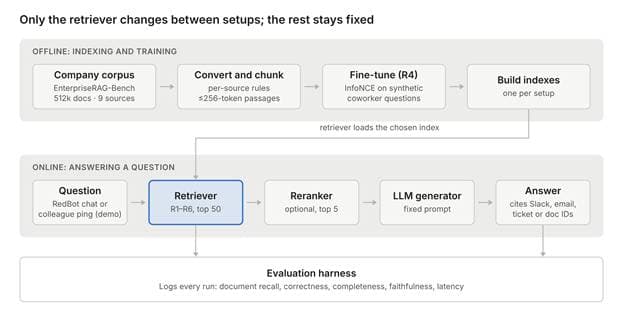
Lumbr is a cited-answer assistant over a fictional company's 512K internal documents. It's built as a controlled experiment: one pipeline in which only the retrieval method changes, so every difference in answer quality can be traced to retrieval.
- Six retrieval setups compared head to head, from keyword search to hybrid search with reranking
- The headline test: a small model, fine-tuned on the company's own documents without any human labeling, against a general-purpose model roughly 35× its size
- An answer generator held fixed that cites every claim back to its source or says the information isn't there
- "First Day at Redwood," an interactive demo. You're a new hire fielding messages from impatient colleagues, and Lumbr is your only help.
I'm leading the project overall, from study design through final results, in a three-person team with Patricia Angeles and Jieun Jeong. Each of us works across every stage.
Outcome (expected)
An evidence-based recommendation for which retrieval setup a company should deploy for an internal assistant, what it costs in speed, and whether adapting a small model to a company's own language is worth it compared with buying a bigger general-purpose one.
Results (expected)
- Retrieval quality for all six setups on 400 held-out questions, led by Recall@10, the benchmark's main metric
- Answer quality and faithfulness: whether answers are correct, complete and actually supported by their citations
- Abstention: how reliably Lumbr admits when the answer isn't in the documents
- Latency per stage, so the quality gains can be weighed against speed
Technical details
The setting
EnterpriseRAG-Bench simulates the internal knowledge of Redwood Inference, a fictional AI-inference company: about 512K synthetic documents from nine tools (Slack, Gmail, Jira, Linear, Google Drive, Confluence, GitHub, HubSpot and Fireflies meeting transcripts). It deliberately includes noise such as near-duplicates and conflicting facts. Because the company is synthetic, no LLM has seen its data, so every correct answer has to come from retrieval.
The pipeline
- Preprocessing and chunking. Each record becomes text with a header (source, channel, author, date), since questions often hinge on who said what and when. Records are chunked along their natural structure (Slack threads, emails without quoted replies, tickets, document sections, transcript windows) into passages of at most ~256 tokens.
- Retrieval and reranking. The retriever returns the top 50 passages, and an optional cross-encoder reranks them down to the top 5.
- A fixed generator. An open 7–8B instruct model at temperature 0 answers only from those passages, cites each claim by document ID, or says the information isn't there.
- An evaluation harness that logs every run.
Six retrieval setups
- R1: BM25 keyword search
- R2: a small general-purpose embedding model
- R3: a ~35× larger embedding model
- R4: R2 fine-tuned on the company's documents
- R5: BM25 fused with the best dense model
- R6: R5 plus a cross-encoder reranker
R4 against R3 is the headline comparison.
Fine-tuning without labels
Following the GPL approach to unsupervised domain adaptation, and without using any benchmark questions:
- Synthetic questions. For 30–50K sampled passages, an LLM writes one or two coworker-style questions that paraphrase rather than copy the passage, so the model learns meaning beyond keyword overlap. A cross-encoder filters out questions their source passage doesn't actually answer.
- Hard negatives. BM25 and the base model surface similar but wrong passages. Because the corpus contains near-duplicates, candidates the cross-encoder judges relevant are dropped, so the model isn't trained to push away correct answers.
- Loss. InfoNCE with in-batch and hard negatives.
Evaluation
The benchmark's 500 questions are split into 100 for development (tuning, early stopping, demo prompts) and 400 held out for reporting.
- Retrieval: Recall@10, nDCG@10, MRR and invalid extra documents, all against gold document IDs
- Answers: correctness and completeness from an LLM judge, plus faithfulness, the share of claims supported by the cited passages
- Abstention: whether Lumbr admits when the information isn't in the corpus
- Latency: median and 95th percentile per stage, on the same GPU for every setup
- Judge validation: all three of us hand-score the same 50 answers, and we report judge–human and human–human agreement (Cohen's kappa)